
The Relationship SCALE (Smile, Connect, Ask, Listen, Engage) is a helpful frame to remind us to focus and scaffold how to actively create positive interactions. It represents simple but powerful intentions and practices to consciously build flourishing relationships, so that we are not just leaving them to chance. Maureen Gaffney’s research outlines that, due to the stickability of the negative, an average relationship needs a ratio of 3:1 positive to negative interactions; a flourishing one that we hope to foster needs 5:1. Check out Maureen Gaffney’s TED for her reflections on how powerful our inner dialogue can be and how important it is to focus on the positive.
The Relationship SCALE helps us to facilitate the 5:1 ratio and reminds us to be proactive, to focus on and create what we want instead of constantly noticing the negative impact of what we don’t want! It reminds us of the action required to follow through on what we already know, that relationships are at the heart of teaching and learning.
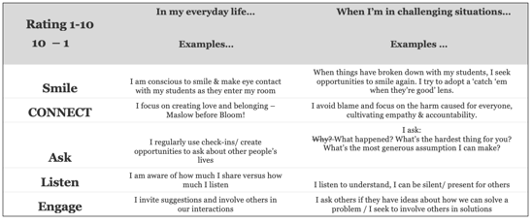
Top Tips 5:1
- Set your intention at the beginning of each day/class - how do you want to feel/be?
- Seek opportunities to smile with a specific student/colleague.
- Send a colleague a thank you email/post it note.
- Share two positives before you share a negative - invite students to do the same.
- Ask "what happened?" instead of "why?".
- If you have a problem - invite the person with the problem to consider/share if they have any ideas about how they/you/we can solve it.
- Take a mindful minute at the beginning of every class/day (begin with a focussing activity to enable this).
- Tap into and share your own personal scripts.
- Introduce a talking piece and do an energy check in/out.
- 'Love Bomb' someone that you are having problems with.
- Send home a good note/call.
- Express gratitude at the end of every school day.
- Give yourself a compliment/celebrate and acknowledge something that is going well each day.
- When in conflict, consider and share your intention to connect/find a solution/work together etc.
- Listen with your ears/body/heart - active and deep listening enables us to be present for others.
When using the Relationship SCALE, the intention is always to turn towards one another, to CONNECT, to move towards love instead of fear when faced with challenge as illustrated in this image called ‘Love,’ by Ukrainian sculptor Alexander Milov at Burning Man illustrates.
Wishing you all the very best for this school year and remember, as the amazing Rita Pierson tells us in her TED talk Every Kid Needs a Champion!

This idea that Restorative Practice is all about the Restorative Questions is a sentiment I hear a lot. Here, I would like to discuss some of the experiences I would have missed out on and some of the things I may not have learned had my learning in Restorative Practice stopped at the Restorative Questions. One of the most disappointing losses one might experience if you focus merely on the Restorative Questions is that of Positive Relationship Building. In September this year I met a little boy in my new class who was very shy, withdrawn and had little self-belief. He struggled academically and explained that he found school really hard sometimes. I was struck by how happy he appeared playing on the yard with his friends but how rapidly his demeanour changed when he re-entered the classroom. It didn’t take me long to figure out the classroom was not a place of safety or welcome for this child. At the end of the first week of school I gave the children big A3 blank white folders and asked them to design and decorate them as they saw fit. I suddenly saw this little boy light up. I went down to his desk and sat beside him. He talked more to me in those 10 minutes than he had for the full week. He explained that he loved to draw and that he created comic books at home. He was engaged, happy and very open with me and I began to see all the wonderful gifts and talents he possessed. From this encounter on, I took every opportunity to praise him for his creativity and to find ways to incorporate this into his learning. I have had the privilege of seeing this child grow in confidence over the last few months. Positive relationship building is something that comes very naturally to many teachers restoratively trained or not. However, what I have learned and what really helped me in this situation was to make this positive relationship building an explicit part of my teaching practise. To make time in the day to build relationships with my students. I have developed simple and manageable procedures such as a checklist of positive interactions to remind myself to praise all of my students. Had I not been using such strategies I may have lost out on this very positive experience and an affirming relationship with one of my students. Another area which falls outside the scope of the Restorative Questions, and is a huge benefit of Restorative Practice is it’s power to support and nurture student’s emotional literacy. In September, I met a group of students who had had little experience of Restorative Practice and I was concerned by their struggle to label and describe their emotions and at times to regulate these emotions. Over the first few weeks of school, I introduced the children to the Restorative Animals, one of whom is Crank the Croc. He can be a little snappy at times and needs understanding and a love bomb to help him to regulate his emotions. Two or three weeks after we had introduced these animals, I noticed one of the little girls in my class was behaving in a manner that was outside the norm for her, she was very sharp with the other children and seemed very frustrated in class. One Friday morning I asked her to have a chat outside the door. I started by telling her I noticed that she was acting differently and I asked “What happened?”. At which point she burst into tears and told me she was just feeling like Crank the Croc, things hadn’t gone according to plan at home that morning and she was in a very cranky mood. So I asked her what does Crank the Croc need to help him when he’s in a bad mood. She replied; “A love bomb” and I asked her what that looked like for her. With some suggestions and scaffolding she decided she’d like to sit beside her friend at lunch and to have five minutes in the Cool Down Corner. At the end of the day I rang her Mam to check in and discovered that the family were going through an extremely challenging time and that things were very emotionally turbulent at home. I have never been so glad that I took an empathetic approach, had I not and had I taken a more punitive approach I feel I would have destroyed my relationship with this student. I would have left school that day with little understanding of that child’s experience and no insight into how to support her for the rest of the school year. Finally, Restorative Practice can act as a powerful lens through which you view your professional and personal interactions with others. A question I learned to ask through Restorative Practice is “Who do I want to be?” As educators we know there are times where so much of a situation is out of our control. This can lead to some very stressful situations when dealing with parents in particular. I find looking at a situation from the parents perspective and recognising that it’s rarely a personal issue with me, rather their deep concern for their child that causes anger and frustration. This helps me to deal with conflict. Also when having contentious meetings with parents I ask myself the question “Who do I want to be?”. It by no means guarantees that I will be met with the same level of empathy but if I can leave such a meeting feeling that I was kind, professional and empathetic well then I’m happy with the only side of the conversation I can actually control.
Sometimes, in my role as Guidance Counsellor, I get asked to intervene in situations where several consequences have already been implemented. One such example was a second year “feud” between a boy and a girl who had no dealings with each other in first year and were in the same class for the first time in Second year. Over the first few months, their bickering had escalated to Year Head intervention, detentions and still the teachers were reporting problems in the class. In fact, the whole class atmosphere had been impacted and the class was labelled the problematic one of Second year. “I felt powerless. I was confused, I couldn’t understand why she was treating me like this. I never spoke to her in First year and when we were put in class together this year she started sniggering and whispering to her friends every time I walked into class for no reason. ” (Boy X) These were the words of the boy in a preparation conversation before a Restorative Meeting. But they didn’t come easy. In the first round of the questions, I learned he was angry and that he thought his reputation was ruined. He couldn’t get beyond defending himself and making her out to be the ‘bad guy’. He wanted compensation and for the Year Head to call an assembly and tell the whole year he didn’t do ‘it’. At that stage, based on those answers, I was skeptical that there was a readiness for a Restorative Meeting between the two parties. In my work as an RP practitioner, I know that identifying what feelings reside behind the facts listed are where connection and empathy are built so I delved a little deeper – back to the start of the story rather than this specific incident. I followed the question protocol again and that’s when we started getting somewhere and he made the above revelation. This boy was very articulate, and I could empathise with the feelings he described. He described the mixed emotions of new beginnings, new classmates, and the added burden of this mysterious quarrel with a girl he didn’t know who just had it in for him. In an attempt to regain power, he began acting in a way that he wasn’t necessarily proud of but couldn’t think of approaching any differently. ‘Investigating’ the incident that landed them in my office wasn’t the priority, giving them clarity and a new path forward were.
Individual and Collective Accountability in a Restorative Framework