A year older...and far wiser
I teach in a good school. It’s academic and my students are high achievers. And I often wonder... What am I teaching them? What am I actually teaching them that they couldn't get out of a book or online? And then an opportunity arises where I can hold up a mirror for a student to reflect on their behaviour, and who they want to be in the world. And those opportunities generally happen when students engage in “bad behavior”.
One example is from last year. I had a third-year SPHE class and we were playing “Rock, paper, scissors, champ” (the team version from the RP Student Mentor Programme). This programme, Be Here, Be You, Belong is a wonderful way to offer connection and peer support. It builds the leadership capacity of young people. I have experienced all of the potential this way of implementing RP in schools and so I am so frustrated when *Jamie (whose name is not Jamie) decided to add in a secret weapon and when the team jumped around, instead of saying rock, paper, or scissors, he shouted “jizz”. The lads on his team burst out laughing and I was fuming. I vividly remember thinking he was making a mockery of my class, trying to show off in front of the lads in the class, and degrading the girls in his class. I also felt foolish for taking a chance on a game and getting it thrown back in my face. Straight away I kicked him out. After a couple of minutes, I went outside to him and just looking at him I could feel my anger rising. I snapped, “I'm too cross to talk to you now. I'll come back in another couple of minutes” and I went back inside. When I calmed down sufficiently, we had a conversation which left an impression on me, and although I no longer teach Jamie I met him this year to ask for his help writing about it. That was an enlightening conversation.
April 2023:
What I said What I was thinking at the time
What Jamie said What Jamie was thinking at the time
What happened?
I didn’t know what I was supposed to say so I just shouted something.
Maybe she didn’t hear exactly what I said so I’ll try to get away with it.
He’s being defensive. This isn’t going to work...
Can’t you see how inappropriate that was?
I was only messing
I can see that it wasn’t great, but I’ll try to deflect.
This definitely isn’t going to work...how can I get him to realise? (I’m starting to panic a bit!)
Do you have a sister?
Nodded
I don’t like where this is going
How would you feel if that happened to your sister?
She’d know I was only messing
I was still focusing on what I did and not how it affected anyone else
It’s not you doing it, it’s someone in her class that she doesn’t know that well. How would you feel if your sister had that done to her?
Shoulders dropped, long pause
This is serious...it’s really bad
I wouldn’t like her to be put in that position, I know she’d be really uncomfortable
I can see his defensiveness drop, he’s got it and I can see how bad he feels. Now, I feel the urge to make him feel better. It’s an instant transformation.
I see you as a leader. Some days in class I think you’re going to be school captain and then other days I think, “Nope, you’re going to get arrested” (I say jokingly)
Jamie is looking at the floor but he smiles
I just wish it hadn’t happened, I wish I could go back and not do it. I’m really sorry for what I did.
That’s kind of funny... but this is clicking how out of line it is, this makes me think of the way my mam reminds me I’m a role model for my younger brother
November 2023
After we had gone through this, I asked Jamie what he thought might have happened if I had gone the route of going to his year head and putting him on detention. This was his (extremely wise) response.
It wouldn’t have made me think about what I had actually done. It would have just built up a hatred towards you and in classes after that it would have just been a battle and I would have been trying to get one up!
I’ve told this story at workshops and been asked whether Jamie has reformed. In all honesty, some days he’s super and sometimes he still makes questionable choices. But I was curious so I asked him if he thought that anything changed for him as a result of this conversation.
I think about others before I act now. I know there’s a line and when the lads come up with an idea of something funny to do I think about it, sometimes I tell them not to do things that I wouldn’t have thought about before.
I’m not trying to suggest that one conversation has reformed this student but I know that I had a conversation with him this year that I could not imagine having 6 months ago. I fully believe that a wise, mature young man was in there regardless of our chat but it was definitely a valuable learning experience. It speaks volumes that he remembered it so vividly months later.
There has always been (and will always be) “bad behaviour”. That is, as long as we define some behaviour as good and some behaviour as bad. I’m now curious about the need under behaviour, like Jamie’s need for reflection, supportive challenge or empathy that day and my need to connect with Jamie in a more positive way.
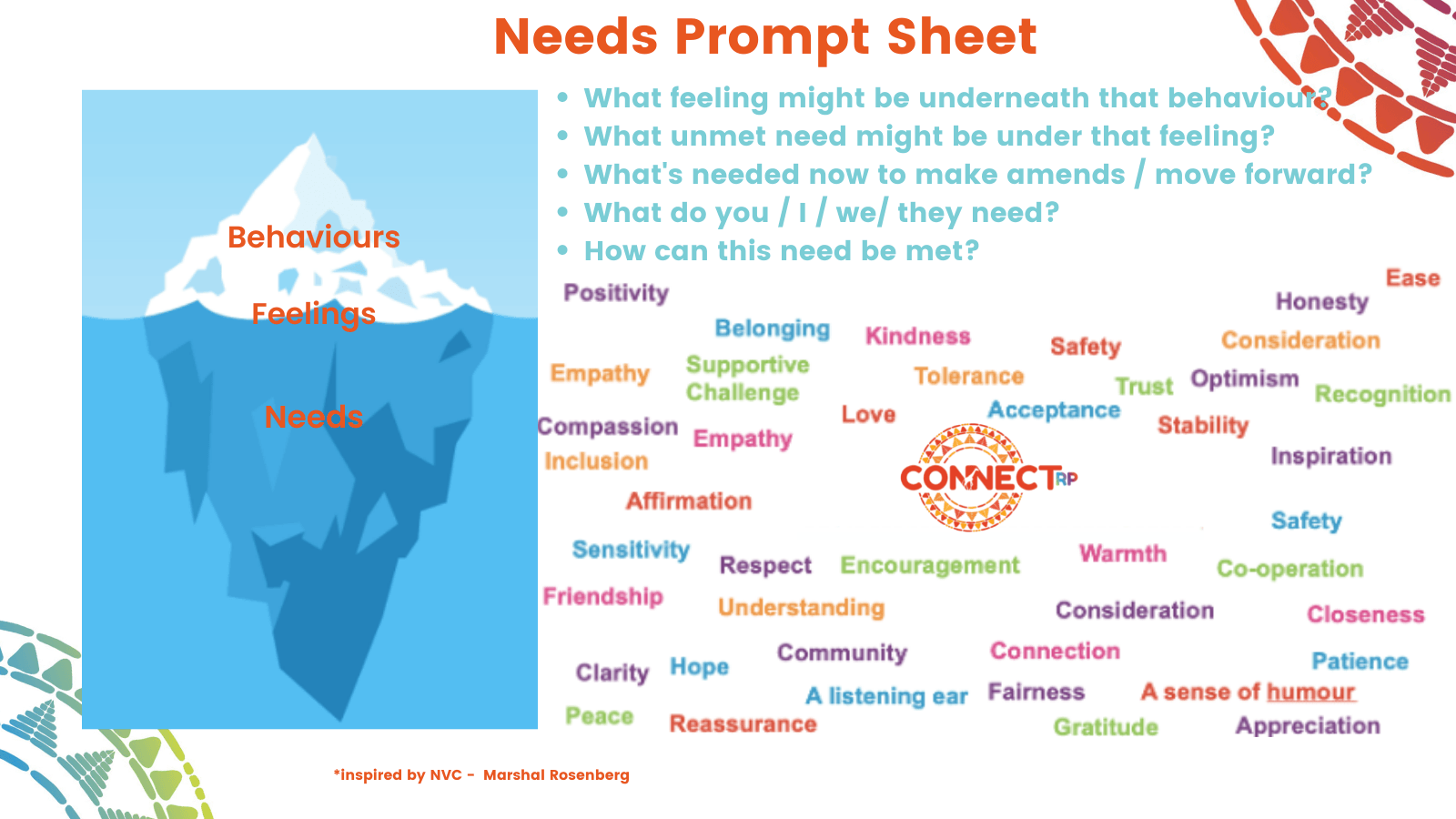
My focus used to be to minimise the bad behaviour and now I seek it out, I relish the opportunity to work with students in this heart space. I try to consider what is this behaviour communicating and engage in conversations that promote empathy and growth. This is where I know they learn something more than what they can find online. It’s where I get to make a real difference and be the change I wish to see!
If you would like to know more about our RP Student Mentor Programme join one of our
Community Cafés on the topic or find out more
here.